Brazil Coffee Harvest 2026/27: A Record Crop on the Horizon
Favorable weather, the positive biennial cycle and expanding cultivation areas point to what could be the largest coffee harvest in Brazilian history.
By Alessio Bernasconi
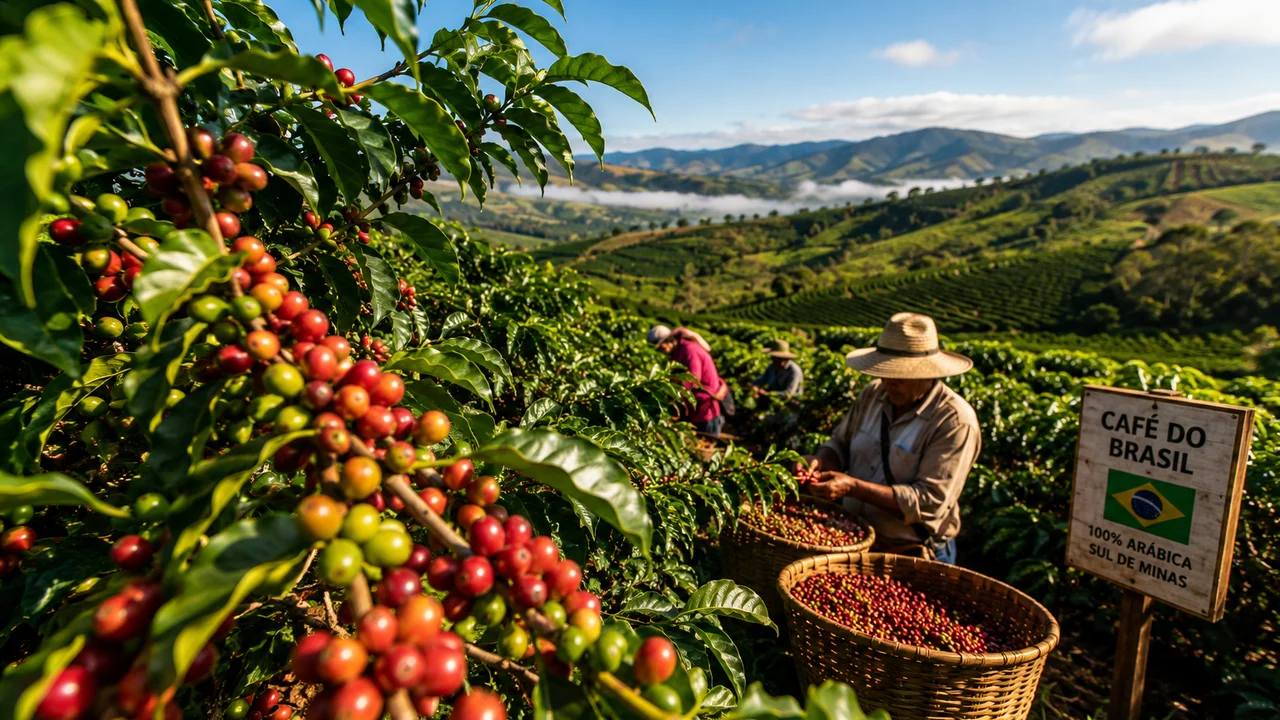
After five consecutive years of disappointing arabica yields, the Brazil coffee harvest 2026/27 is shaping up to be a landmark season. A powerful combination of favorable weather, the positive biennial cycle, expanding cultivation areas, and better crop management practices has set the stage for what could become the largest coffee harvest in Brazilian history.
A Potential All-Time Record
According to the USDA's Brasilia Office of Agricultural Affairs, total Brazilian coffee production for marketing year 2026/27 (July to June) is forecast at 71.9 million 60-kg bags, a 14% increase over the 63 million bags estimated for 2025/26. Brazil's own National Supply Company (CONAB) puts the figure at 66.7 million bags, which would still surpass the previous record set in 2020. Both estimates agree on the direction: this will be a bumper crop.
The growth is broad-based. Cultivated areas are expanding across the country in response to strong global demand and historically elevated coffee prices. Advances in agricultural technology now allow producers to plant more trees per hectare, amplifying the yield gains that come from a favorable production cycle.
Arabica Leads the Charge
Arabica production is the headline story of the Brazil coffee harvest 2026/27. Output is forecast at 47.5 million bags, a 25% jump compared to the previous season. The key drivers are well-aligned this year: the biennial cycle is in its high-output "on year," rainfall ahead of and during flowering in September and October 2025 was sufficient despite some irregularity, and conditions normalized by early 2026 to deliver excellent fruit development.
Minas Gerais, responsible for nearly 72% of Brazil's arabica output, is expected to post a 26% production increase, driven by a 5% expansion in harvested area and a 20% improvement in yields. São Paulo and Espírito Santo are also reporting strong arabica seasons, both pointing to growth above 15%.
The favorable exchange ratio between fertilizer costs and coffee prices throughout 2025 gave producers an additional incentive to invest in crop inputs, further supporting this season's strong performance.
Robusta Holds Steady
While arabica steals the spotlight, robusta/conilon production is forecast at 24.4 million bags, a modest dip from the 25 million bags estimated in 2025/26. That slight decline follows an exceptional prior season and reflects cooler temperatures and above-average rainfall in some key growing regions. Espírito Santo, which alone supplies around 20% of the world's robusta, expects output to fall approximately 4% versus last year's record, while Rondônia is a notable bright spot with a forecast increase of more than 19% thanks to crop renewal with higher-yielding clonal varieties.
Bahia continues its rapid ascent as a robusta powerhouse, leveraging irrigation technology and government investment to consistently push production higher and strengthen its position as Brazil's second-largest robusta state.
El Niño: The Variable to Watch
No analysis of the Brazil coffee harvest 2026/27 is complete without addressing the El Niño risk. NOAA currently estimates a 60% probability of El Niño conditions developing between May and July 2026, with models from the IRI projecting those conditions extending into early 2027.
For the current 2026/27 harvest, the immediate concern is limited: Brazil's winter is expected to bring fewer frost events, and the crop is already showing excellent productivity. However, El Niño poses a real threat to the 2027/28 cycle. Above-average temperatures during flowering and shifts in rainfall patterns could weigh on future yields for both arabica and robusta. We explored how this climate signal is colliding with other supply-side shocks in El Niño and the Strait of Hormuz: Two Shocks, One Fragile Market.
Brazilian producers are already reacting. Many are holding back on sales of remaining 2025/26 inventory, waiting to see how El Niño develops. This cautious stance is one reason coffee prices have not fallen as sharply as the production forecast might suggest.
Export Surge and Market Implications
With a record crop in sight, Brazilian coffee exports for 2026/27 are forecast to surge by 30%, reaching approximately 49 million bags across green bean, roasted, and soluble categories. Yet exporters remain selective. Low current stock levels and El Niño uncertainty are keeping traders from committing aggressively to forward contracts, providing a floor under prices even as the new crop arrives.
For global coffee markets, the Brazil coffee harvest 2026/27 represents a major supply event that will influence prices, trade flows, and roaster procurement strategies well into 2027. Buyers sourcing Brazilian arabica at scale should take note: the window of abundant supply may be shorter than the production numbers alone suggest. For traders looking to stay ahead of consensus positioning in markets like this one, see Crowded Trades and the Edge of Alternative Data.
Data sourced from USDA/Brasilia Office of Agricultural Affairs, CONAB, and IBGE (June 2026).